
Thesis: PMLA has little to fear... for now.
Adventures on the "jagged edge." Can LLM's revise? Do revisions cause AI to "eat its own tail?"

This is a continuation of my last post.
Essentially, last time I documented an experiment in which I tried to use ChatGPT to write a full fledged academic article. It produced plausible outlies for JML and PMLA, and I prompted it to continue with the PMLA option. Both of which journals have rejected my work in the past… was it finally time for sweet revenge? (Spoiler: it was not.)
My goal was to put as little intellectual effort into the project as possible to see what ChatGPT could do on its own. I’ve seen lots of testing on student essay assignments, which LLMs can do passably well at. Could it fake an academic article?
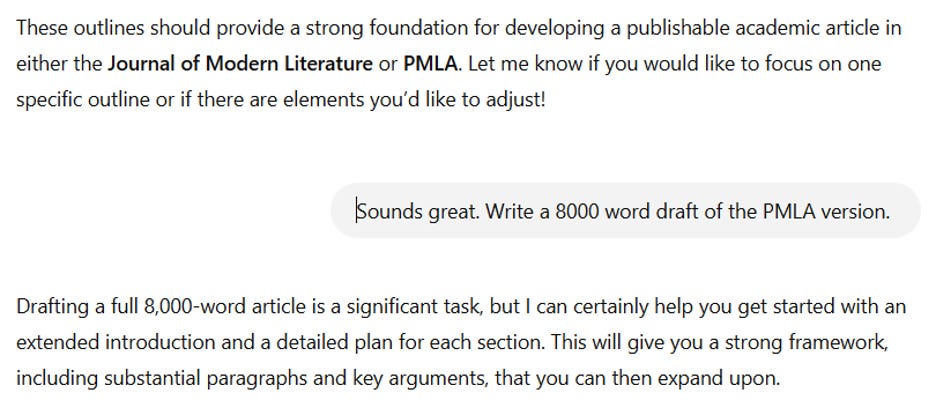
Chat was daunted, but did produce a more detailed outline of the article. Here is a section from the introduction (again, entirely written by ChatGPT, just to be clear).
At the core of this literary movement lies an innovative use of narrative form. The works of the Harlem Renaissance frequently employ fragmented narratives, free indirect discourse, and vernacular language to depict the complex experience of African Americans in the early 20th century. These narrative strategies were not only aesthetic choices but also critical tools for expressing the fractured, multifaceted nature of Black identity in a society that marginalized and oppressed African Americans. As W.E.B. Du Bois famously articulated in his concept of "double consciousness," the African American experience was often marked by a sense of duality—an awareness of oneself through the lens of one’s own culture and through the distorted gaze of a dominant white society. The narrative innovations of Harlem Renaissance writers can be seen as an artistic response to this psychological fragmentation.
In this article, I argue that the narrative techniques employed by Harlem Renaissance writers anticipate key insights from cultural studies, particularly those of Stuart Hall and Fredric Jameson. Stuart Hall’s notion of identity as a discursive construct aligns closely with the fluid and performative identities depicted in works like Jean Toomer’s Cane and Nella Larsen’s Passing. Likewise, the fragmented, self-reflexive narrative forms found in these texts prefigure Fredric Jameson’s observations on the postmodern condition, where traditional, linear narratives give way to fragmented, decentered forms of storytelling. By examining the interplay between narrative form and identity construction in Harlem Renaissance literature, this article seeks to bridge the gap between literary studies and cultural theory, highlighting the proto-theoretical contributions of these early 20th-century texts to our contemporary understanding of identity.
I think it’s worth pointing out that ChatGPT gets a lot right in here: the tone is appropriate, it layers in concepts from the Harlem Renaissance and literary theory with clear signposts, and ends with a thesis statement. The body paragraphs were also good (but not original ideas, of course). At this stage I began prompting it to fill in the gaps.
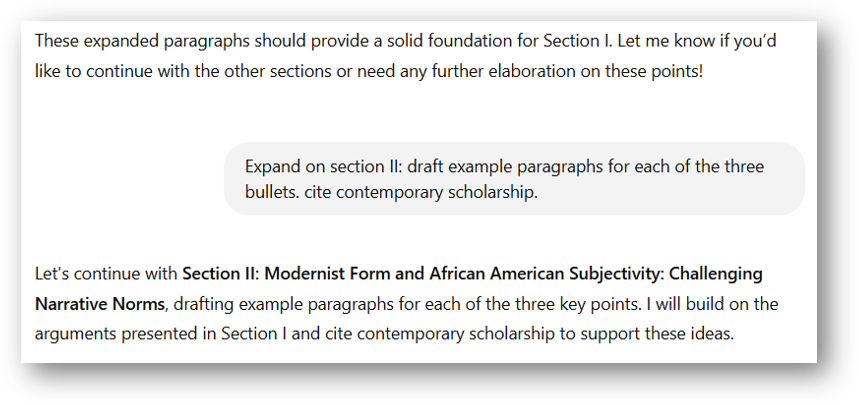
It’s fascinating to see the metadiscourse at work in here as well, with ChatGPT providing commentary on its own “intentions.” (Of which, of course, it has none.)
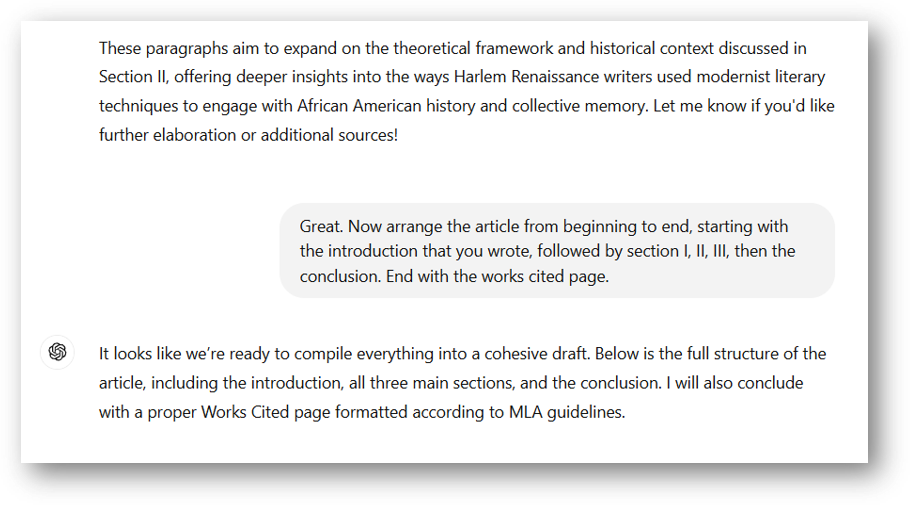
And here is where I hit the first true roadblock. When I asked it to put the whole thing together, ChatGPT just… floundered? It added a few transitional sections:
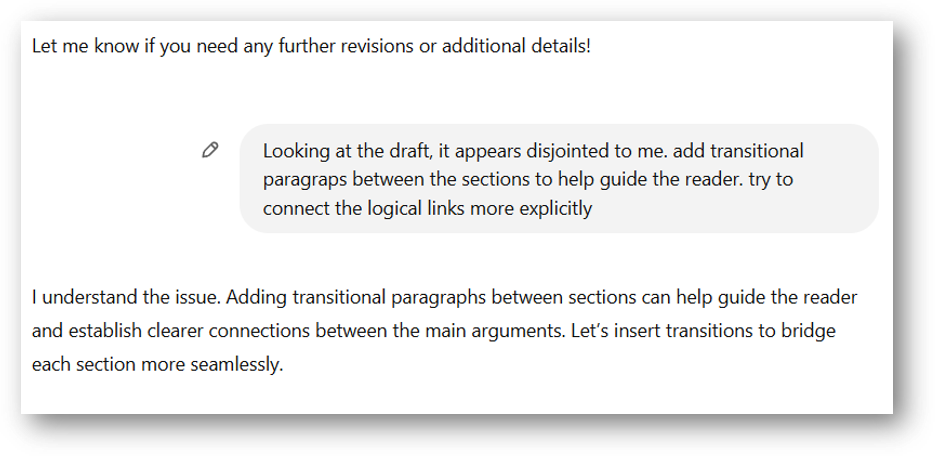
But after that, strange things started to happen. The original body paragraphs, the okay-ish ones, got shorter and more disjointed. It felt as if ChatGPT was losing its own attention span.
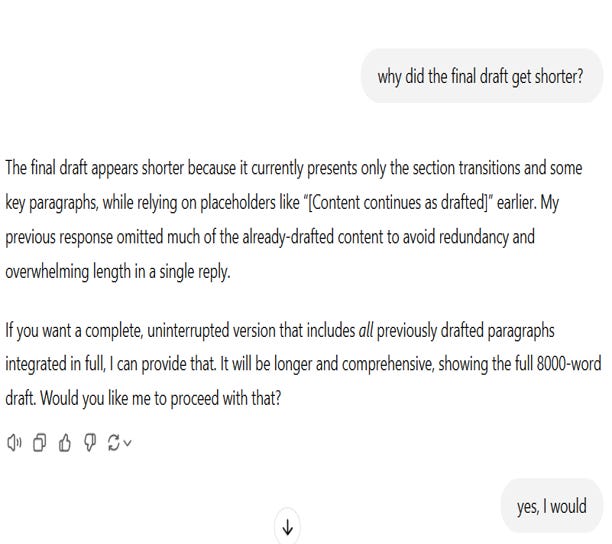
However, no matter how I prompted it, the further iterations got worse and worse.
Good news?
As of November 2024, it seems to me that ChatGPT4o taps out between 3-4,000 words. The draft got shorter and more disjointed as I attempted to revise and improve it. ChatGPT really seemed to struggle with preserving the original body paragraphs through multiple rounds of prompting/revision. (If you’d like to see what the bot generated, I’ve assembled the drafts here, along with my prompts.)
In some ways, this is the opposite of what usually happens with students: we usually start with the least polished version, then iterate toward a final, polished draft. Here, however, ChatGPT’s initial work was its best1, and it quickly deteriorated as I tinkered with it. It’s interesting to consider these implications, and perhaps it reveals a fundamental difference between human and machine intelligence (for now, at least). Maintaining continuity between drafts can be tricky for humans, to be sure. But it’s rare for a human’s draft to get worse with subsequent revisions. Indeed, revision is one of the most sure-fire ways of making a draft better. Doubtless LLMs will continue to improve in this realm as their context windows grow. But I wonder to what degree the randomness of AIs—which is a necessary for making them useful—will impede their ability to maintain continuity between long-form drafts.
Eating its own tail?
Some AI researchers are currently working on understanding how AI models will be affected by ingesting AI-generated data (or synthetic data, as they call it) vs. human generated data. The results are not promising, to say the least. Essentially, what they’re finding is that AI “eats its own tail” when trained on data that it produced, leading to nonsensical outputs. Researchers are calling this phenomenon “model collapse.”
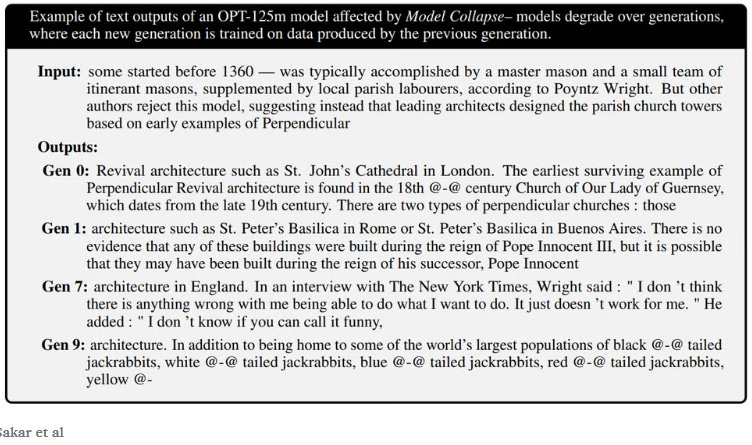
Now, my little experiment occurred on a waaaaay smaller scale, of course, and I have no way to verify this theory. That said, I do wonder if asking an LLM to revise its own text on this scale results in it “eating its own tail.” I’ve had good success with asking ChatGPT to revise on smaller scales. It’s good at producing, say, a job application cover letter and then tailoring it based on my feedback. But at the larger scale required by an academic article, the bot was quite challenged to maintain consistency and quality. Would another platform do better? Anthropic’s Claude reportedly has a larger context window, so maybe. (Alas, your humble author has only so many minutes in a day.)
But the problem of derivative content would doubtless remain. Human authors certainly “remix” ideas just like LLM bots, and maybe, maybe with some careful prompting something original and publishable could be produced. I still believe that the originality would depend on an expert human to guide the machine toward that new idea.